
The wire transfers. The papers are signed. Everyone around you is celebrating, and by every measure that matters, you should be celebrating, too. But somewhere underneath the relief, there’s a weight you weren’t prepared for, an ache that doesn’t match the good news.
If that sounds familiar, you’re not imagining things, and you’re not alone. The emotional impact of selling a business often surprises even owners who planned every financial detail, and what you’re feeling has a name. The path through it is more predictable than it might seem from where you’re standing now.

For most owners, a business is never just a financial asset. It becomes the organizing principle of daily life, the reason you wake up early, the source of your sense of purpose, and often the primary way your community defines you. Psychologists call this fusion of self and enterprise “entrepreneurial identity,” which helps explain why roughly 65% of business owners report their identity is deeply tied to their business, according to a 2025 national study. When the sale closes, that entire structure disappears at once.
Because the outcome appears successful, sellers often receive little social permission to grieve it. Friends expect celebration, advisors move on to the next deal, and the seller is left processing a profound loss alone. Psychology Today describes this experience as a hidden grief of letting go, a reaction many founders never see coming.
Sellers may notice themselves second-guessing the deal or reconsidering a buyer they’d already trusted. These reactions come from the mind protecting something it isn’t ready to release, not strategic doubts. They’re a normal, predictable part of a major life transition, not a sign of weakness.
The grief process that comes with selling a business follows a recognizable arc, and knowing the stages in advance is preparation most sellers never get. Even before the papers are signed, exhilaration at the possibility of an exit often gives way to doubt, then oscillation between wanting to sell and wanting to hold on.
Second thoughts here are almost universal. The stress of keeping the sale confidential from employees, suppliers and family adds to the emotional load during this window.
Closing day brings real, deserved emotion. Relief washes over most sellers first — the deal is done, the risk is behind them, and the hardest negotiations are finally over. Pride follows close behind, a genuine sense of accomplishment for building something worth this much to someone else. These feelings aren't exaggerated, and they deserve to be felt fully. But many sellers also notice an unexpected emptiness underneath the celebration. The calendar that used to be full is suddenly open, and decisions that once demanded immediate answers no longer come. A disorienting "now what?" starts to surface, even in the middle of good news. Relief and a sense of loss can exist in the same moment. Feeling both at once is the normal human response to a profound transition, and it doesn't undo what you accomplished. The early weeks after close often feel like a honeymoon phase, a stretch of genuine celebration before a deeper emotional shift arrives.
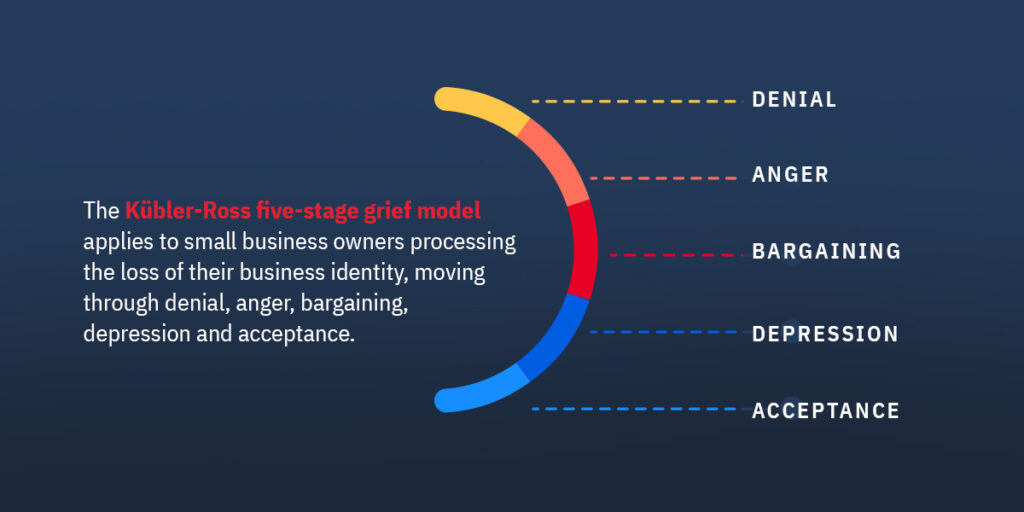
For many sellers, the deeper dip arrives weeks or months later, and it has a name — post-sale depression. Mornings that once started with urgent decisions now start flat. The daily structure the business provided, the team, the challenges, and the sense of forward motion are simply gone, and the drift that follows can catch even carefully planned exits off guard. The Kübler-Ross five-stage grief model applies to small business owners processing the loss of their business identity, moving through denial, anger, bargaining, depression and acceptance. This rarely happens in a neat order, and sellers often cycle back through earlier stages before moving forward. Many sellers experience the sharpest dip months after the honeymoon phase fades, once the loss of daily purpose and team fully sets in. With the right strategy and support, it's possible to work through this phase.
Rebuilding a sense of purpose after a sale doesn't happen automatically, but it is possible, and it starts with giving yourself permission. Many transition advisors suggest treating the first few months as a neutral zone, a period of disorientation without rushing into a major new commitment. From there, deliberately building new routines and structure matters more than many sellers expect, and so does reinvesting in relationships and interests that existed long before the business did. The psychological ownership is not fixed. Owners can cognitively and emotionally separate themselves from the business they'd sold, gradually and over time, rather than staying tied to it indefinitely. That emotional transition after a business exit is real, and it's survivable. Sellers who want a fuller roadmap through this next chapter can find one in life after selling your business, which walks through what rebuilding looks like in practice.

Reaching out for help with this transition doesn’t mean the process failed you — it means you’re preparing for a major change, just as you’d prepare for any other. But if joy or motivation feels persistently out of reach months after close, if you’re withdrawing from relationships, struggling to sleep or concentrate, or feel a loss of purpose with no sign of rebuilding, it may be worth talking to someone.
Coping with selling a business can be easier with real support:
A partner who recognizes that selling is both a financial transaction and a human transition makes the experience more manageable at every stage.

Selling a business brings both financial outcomes and profound personal change. The emotional transition is real, common and navigable with the right support and realistic expectations about what the adjustment requires.
At Inbar Group Inc., we’ve spent more than 30 years understanding that. As Northeastern business brokers, we meet in person and come to you because trust gets built face-to-face.
If you’re considering selling your business, connect with a broker to start the conversation and request a free business valuation opinion.
If you’d like to learn more first, our tutorial on selling your business and FAQ for sellers cover what to expect along the way. As a Best of Small Business Awards recipient, we’d be honored to guide you through this transition.
Main Office
Administration and Mail
209 West 29th Street
Suite 318
New York, NY 10001
Phone: 212-473-5000
Connecticut Office - Hartford
Pennsylvania Office - Pittsburgh
1001 Liberty Ave, 5th Floor
Pittsburgh, PA 15222
Phone: (215) 461-5000
Pennsylvania Office - Philadelphia
Two Liberty Place
50 South 16th Street
17th floor
Philadelphia, PA 19102
Phone: 215-388-2334
INBAR GROUP, INC.
Business Sales & Acquisitions
info@inbargroup.com
Main Office
Administration and Mail
209 West 29th Street
Suite 318
New York, NY 10001
Phone: (212) 473-5000
Email: info@inbargroup.com
New York, Manhattan Office
1411 Broadway
16th Floor
New York, NY 10018
Phone: (212) 473-5000
Email: info@inbargroup.com
New York, Westchester Office
112 S Main Street,
Port Chester NY 10573
Phone: (212) 516-2818
Email: info@inbargroup.com
New Jersey Office
2 University Plaza
Suite #100
Hackensack, NJ 07601
Phone: (201) 474-3000
Email: info@inbargroup.com
Pennsylvania & Delaware Office
Two Liberty Place,
50 South 16th St., 17th floor,
Philadelphia, PA 19102
Phone: (215) 388-2334
Email: info@inbargroup.com
Washington DC, Maryland & Virginia Office
650 Massachusetts Ave NW,
Suite # 600,
Washington D.C. 20001
Phone: (202) 516-7800
Email: info@inbargroup.com
Connecticut, Greenwich Office
177 West Putnam Ave. Ste 12609
Greenwich, CT 06831
Phone: (475) 253-3352
Email: info@inbargroup.com
Maine, Vermont, New Hampshire & Rhode Island Office
12 Shuman Ave. Suite #10,
Augusta, ME 04330
Phone: (207) 480-1113
Email: info@inbargroup.com
Massachusetts, Boston, Office
770 Legacy Place
Dedham, MA 02026
Phone: (617) 934-8000
Email: info@inbargroup.com



© 2026 Inbar Group, Inc. Terms of Service | Privacy Policy | Cookie Policy | Site Design by Deal Studio